Commitment to Origins Part 2
Starbucks is taking important measure to help improve the lives of coffee farmers and protect the environment where they grow their beans.
We’ve examined many issues that farmers face, including economic challenges and environmental concerns.
Transparency
- For all coffee Starbucks buys, it is our goal to pay premium prices that result in a profit for the farmer.
- Starbucks pays substantially above commodity prices for our coffee. Because of our size, we purchase coffee from a variety of sources, including individual farms, cooperatives representing many farms and exporters buying from farms.
- In all cases, we want to know that the farmer receives an equitable and profitable share of the money we pay.
- In 2003, we began inserting transparency into our standard contracts. In FY 2005, 93%of our coffee contracts included an economic transparency clause requesting documentation of payments made to various participants in the supply chain. In 87% of these contracts, economic transparency was provided to the farmer level.
- While we are encouraged by the progress our suppliers have made to provide economic transparency, institutionalizing this practice continues to pose enormous challenges as this documentation varies widely in quality, detail, units of measure, currency and language. It is our goal to verify the submitted evidence and reach a high level of assurance that all of the coffee we purchase results in the farmer receiving a profit.
- Requiring economic transparency is a relatively new practice in the coffee industry. While achieving it continues to be challenging, we are committed to having transparency in prices paid to the farmer. Starbucks supports efforts to make this practice common throughout the coffee industry worldwide.
Providing Access to Credit
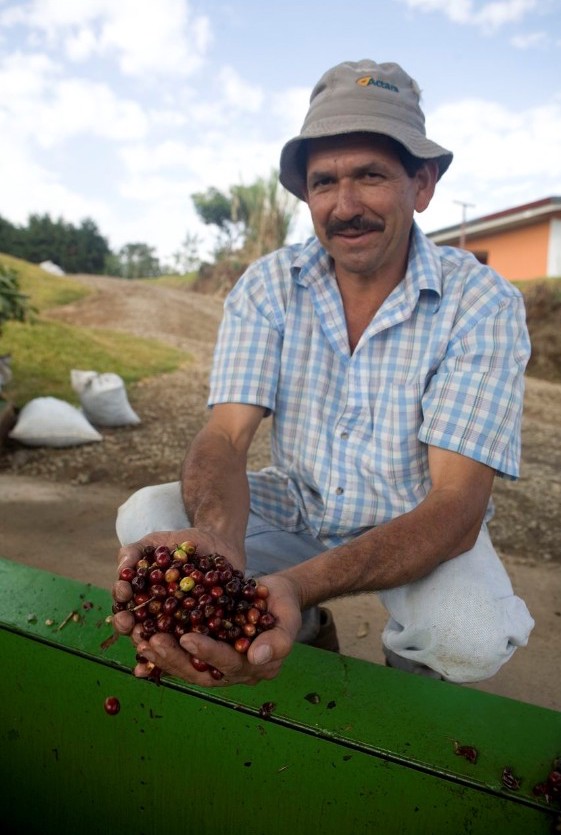
- Coffee farmers often face a shortage of cash before harvest, which forces them to sell their crops early to local buyers for prices lower than what they would otherwise earn.
- Starbucks invests in loan guarantees allowing thousands of farmers to have access to affordable credit. This credit allows farmers to invest in their farms and helps them through cash shortages during crop cycles.
- Through 2005, Starbucks has committed to dispersing more than $8.5 million in funding to nonprofit organizations that provide loans to coffee farmers, benefiting approximately 32,000 small-scale coffee farmers. This commitment is the largest of its kind for a specialty coffee retailer.
- Organizations distributing these funds include Calvert Foundation, EcoLogic Finance and Verde Ventures (managed by Conservation International).
Social development in coffee communities
Starbucks works with coffee farmers, cooperatives, mills, exporters and their communities to build schools, health clinics and other projects that benefit coffee-growing communities.
Starbucks funds these projects in the following ways:
- Award money to farmers— e.g., $15,000 for each Black Apron Exclusive coffee, for use in coffee community projects Partnerships with non governmental organizations — e.g., Conservation International and Starbucks working with farmers in Chiapas to improve the quality of coffee.
- Social premiums on coffee contracts, which are price premiums paid to farmers above and beyond the negotiated rate for quality coffee, used to support community projects — e.g., Ayarza Clinic and Kindergarten in Guatemala.
- Market business units funding projects outright — e.g., Starbucks UK commitment to working with Bensa Ware, Ethiopia to create a source of clean drinking water for the community.
Starbucks investments are often matched and facilitated by participants in the coffee supply chain.
Examples include:
- Worked with CAFCOM to fund the San Miguel Medical clinic offering free medical and dental care to employees’ and suppliers’ families in San Miguel, Guatemala. The clinic served approximately 1,600 patients in 2005.
- Provided $73,000 in 2005 to construct a new library and furnish books for Daye high school in the Bensa Ware region of Ethiopia, as well as new textbooks for a local primary school that has helped to dramatically increase scores on 8th grade national exams.
- Worked with Cooperative Café Timor to refurbish a gravity-fed water system of 11 holding tanks, serving 1,200 people in Estad, Ermera district.
Certified Coffees
Certified organic coffee is grown without the use of synthetic pesticides, herbicides or chemical fertilizers, which helps maintain healthy soil and ground water. The beans must also be processed in certified organic mills and roasting facilities. Official certification requires farms to submit to three years of soil testing, and annual testing thereafter, to verify they are using accepted organic farming practices.
Fair Trade Certified coffee is an integral component of our certified coffee offerings
Purchasing Fair Trade Certified Coffee is one way that Starbucks supports cooperatives of small-scale farmers and is part of a larger, integrated approach to coffee corporate social responsibility. Starbucks and the Fair Trade movement share common goals:
- To ensure farmers receive an equitable price for their coffee.
- To strengthen coffee farms for the future.
- Starbucks is the largest purchaser of Fair Trade Certified coffee in North America and our purchases are growing rapidly.
- Starbucks sells Fair Trade Certified coffee around the world.
- We are the only company licensed to sell Fair Trade Certified coffee in 23 countries and regions: These include: United States, Canada, Germany, Austria, Spain, Switzerland, England, Scotland, Wales, Australia, Japan, Korea, Malaysia, New Zealand, Philippines, China, Singapore, Taiwan region, Thailand, Indonesia, Cyprus, Greece and France.
- Starbucks buys Fair Trade Certified coffee because it benefits small-scale coffee farmers organized into cooperatives. Starbucks is increasing the use and visibility of Fair Trade Certified coffee throughout our business by: Highlighting our new Fair Trade Certified blend, Café Estima, as “Coffee of the Week” on a quarterly basis in North America
- Selling whole bean and ground Fair Trade Certified coffee by the bag.
- Making additional Fair Trade Certified coffee options available to college and university accounts.
- Working actively with TransFair USA to promote Fair Trade Certified coffee.
- Utilized in coffee blends to meet specific taste profiles. These products, however, cannot be marketed or sold as Fair Trade Certified because the use of Fair Trade beans in these blends is not 100 percent.


